
Air-to-Air Heat Pumps vs Radiators: Real-World Efficiency and Running Costs
Examining running costs and operational efficiency between air-to-air cooling/heating units and wet hydronic central heating systems.
When British homeowners consider modernising their space heating and summer cooling, the comparison between air-to-air heat pumps and conventional radiator-based central heating is a central consideration. While wet central heating systems powered by gas boilers remain widespread, their operating model differs fundamentally from convective air-to-air split systems.
Traditional gas boilers function at seasonal efficiencies between 85% and 92%, consuming roughly one kilowatt-hour of fuel to generate less than one kilowatt-hour of usable heat. In contrast, modern inverter air-to-air heat pumps operate on thermodynamic vapor-compression cycles. By moving heat rather than burning fuel, they achieve seasonal coefficients of performance (SCOP) regularly exceeding 4.0. This means each unit of electricity consumed yields four units of thermal energy, offsetting the higher unit cost of electricity relative to domestic gas.
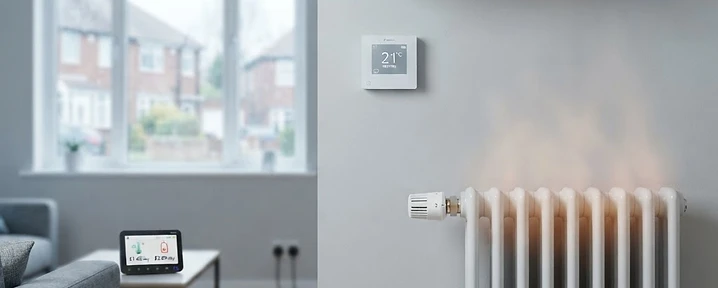
A key practical distinction is thermal inertia. Hydronic radiators require considerable time to circulate heated water and elevate room ambient temperatures through passive convection. Conversely, air-to-air wall units discharge conditioned air directly into the space, delivering comfortable conditions within minutes. For individuals working from home or occupying single rooms, this localised zonal control eliminates the expense of heating unoccupied rooms throughout the entire house.
Crucially, air-to-air split systems offer year-round utility that radiator networks cannot match: active, high-efficiency refrigeration cooling. When summer temperatures climb, a simple setting change switches the unit to heat extraction mode, dehumidifying and cooling living spaces on negligible power. For UK homeowners seeking flexible climate control and decoupled dependence on gas networks, split air conditioning delivers compelling economic and comfort advantages.