
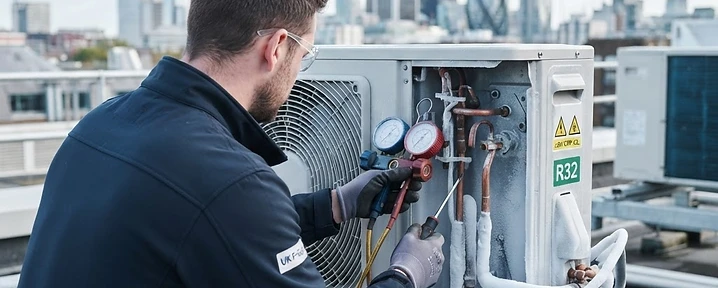
UK F-Gas Transitions Accelerate Move to R32 and Low-GWP Coolants
Stricter refrigerant regulations and eco-design standards are pushing British air conditioning suppliers toward lower-GWP alternatives.
The UK heating and cooling industry is navigating an accelerated transition toward environmentally friendly refrigerants, driven by stringent F-gas regulations and the UK's legally binding greenhouse gas reduction targets. As legacy high-GWP refrigerants face phased quotas and tighter supply limits, manufacturers and trade installers are standardising on next-generation alternatives such as R32 and natural hydrocarbons.
For decades, R410A served as the primary refrigerant for domestic split systems, despite carrying a Global Warming Potential (GWP) exceeding 2,000. Under updated regulatory frameworks, manufacturers have transitioned product lines toward alternatives like R32, which possesses a GWP of 675—roughly one-third that of R410A. Crucially, R32 systems exhibit superior thermodynamic efficiency, allowing installations to operate with smaller refrigerant charges while delivering higher volumetric capacity.
In tandem with chemical refrigerants, commercial and residential markets are observing increased deployment of R290 (propane) in specialised sealed circuits, providing a GWP value of just 3. These developments are directly reflected in updated UK energy labelling, where consumers can clearly evaluate Seasonal Energy Efficiency Ratios (SEER) alongside environmental credentials.
For UK consumers and facility managers, purchasing equipment charged with lower-GWP refrigerants guarantees compliance, lowers future servicing costs, and simplifies end-of-life reclamation. As trade bodies enforce certified F-Gas handling standards, the British HVAC sector continues to modernise, ensuring indoor climate control supports long-term net zero objectives.